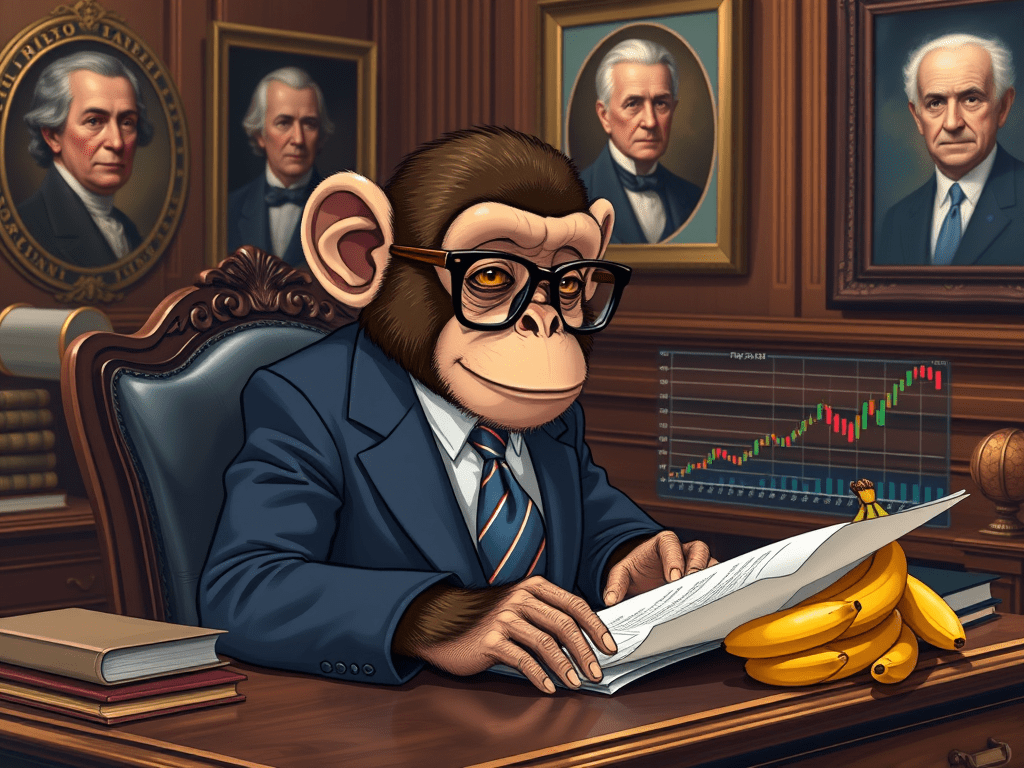
Monkey Momentum Index Score: 9.5/10 🍌
Maurice has been obsessively throwing bananas at historical market charts while wearing progressively smaller presidential wigs. His deep dive into presidential market cycles has him organizing bananas by administration and questioning everything he thought he knew about political market impact.
Breaking down the Presidential Impact Score:
- FDR New Deal Era: 9.8/10 🍌 (Revolutionary banana distribution)
- Post-War Boom: 9.6/10 🍌 (Banana prosperity peaks)
- Modern Era Impact: 9.4/10 🍌 (Complex banana patterns)
- Crisis Management: 9.5/10 🍌 (Banana recovery strategies)
- Policy Effectiveness: 9.2/10 🍌 (Mixed banana results)
Late one night in his research treehouse, Maurice was spotted doing something unusual – he was arranging bananas into presidential timelines while wearing a tiny powdered wig. What could have our primate analyst so fascinated with political history? The answer lies in patterns that span longer than Maurice’s oldest banana preservation experiments.
You see, Maurice has been studying how markets react to different presidential administrations, and what he’s discovered has him doing historical reenactments with his banana collection. While most analysts focus on short-term political drama, Maurice has found something far more interesting in the long-term data.
Starting with FDR, Maurice excitedly demonstrates the New Deal era using bananas arranged in a perfect “V” shape – representing the dramatic recovery from the Great Depression. “Ook ook!” he exclaims, pointing to how the market responded to revolutionary policy changes. Banking reforms, Social Security, and massive infrastructure projects reshaped the financial landscape like a perfectly organized banana plantation.
But here’s what really got Maurice excited – the post-war boom under presidents like LBJ. He demonstrates this by stacking bananas higher and higher, showing how programs like the Great Society and Medicare created new market opportunities faster than Maurice could count his daily banana ration.
The Carter years had Maurice doing his “stagflation shuffle” (it’s quite a sight). Using slightly bruised bananas to represent the economic challenges, he shows how even difficult periods created innovation opportunities. “Energy crisis means clean energy innovation!” he gestures while setting up a miniature solar panel made of banana peels.
Reagan’s era got Maurice so excited he put on a tiny cowboy hat. Supply-side economics might be controversial, but Maurice’s banana charts show undeniable market gains. He demonstrates this by arranging bananas in a “trickle-down” pattern (though he notes some bananas seemed to get stuck at the top).
The Clinton years had Maurice learning to code with bananas. The tech boom created wealth faster than Maurice could peel his morning snack. Though he notes, adjusting his tiny saxophone, that some of those gains had the stability of a banana peel on a waxed floor.
Obama’s term got Maurice practicing his crisis management skills. Using bananas to represent market recovery patterns, he shows how unprecedented intervention helped prevent a complete financial potassium shortage… er, market collapse.
The Trump years had Maurice’s banana trajectories going wild with volatility. Tax cuts, trade wars, and eventually a global pandemic created market movements that had Maurice installing seat belts in his research treehouse.
But here’s what really made Maurice’s historical analysis interesting – the patterns that emerged across all administrations. While arranging his “century of bananas” timeline, he noticed something fascinating: markets tend to climb regardless of who’s in office, though the path can vary dramatically.
“Eek eek!” Maurice exclaimed while arranging his historical market bananas into clear patterns. The really fascinating part, he demonstrates by creating an elaborate fruit-based timeline, is how certain sectors thrive under different administrations. Defense stocks during FDR’s war years soared higher than Maurice’s highest banana toss, while technology under Clinton grew faster than his most ambitious banana breeding program.
Speaking of patterns, Maurice spent an entire week analyzing crisis response across different presidencies. Using bananas in various states of ripeness to represent market stress, he noticed something intriguing – markets seem to care less about which party is in power and more about the decisiveness of the response. “Ook ook!” he gestures, showing how both Republican and Democratic administrations saw market recoveries when they acted boldly.
But here’s what really had Maurice doing backflips in the research department – the impact of Federal Reserve policy across administrations. He demonstrates this by creating a complex pulley system with bananas representing interest rates. Turns out, the Fed might have more impact on markets than any president’s policies, though Maurice notes this is a rather “un-banana-popular” observation among political analysts.
The regulatory impact across administrations had Maurice building his most elaborate banana chart yet. From FDR’s banking reforms to Clinton’s financial deregulation, to Obama’s post-crisis rules, each shift created winners and losers faster than Maurice could reorganize his banana storage system.
Tax policy analysis had Maurice particularly animated. Using different-sized banana bunches to represent tax rates, he shows how markets often react more to the expectation of tax changes than the actual implementation. “Sometimes,” he demonstrates by slowly peeling a banana, “it’s all about anticipation.”
But perhaps most fascinating was Maurice’s discovery about market performance during presidential transitions. While everyone else was throwing bananas at election results, Maurice noticed that markets tend to find their own path regardless of electoral outcomes. His detailed banana-based calculations show that long-term economic cycles and global trends often matter more than who’s sitting in the Oval Office.
The Bottom Line:
After throwing bananas at a century of market data, Maurice’s conclusion is both simple and complex: Presidents matter, but perhaps not in the way most investors think. As he demonstrates with his final banana arrangement, successful investing might have less to do with who’s in office and more to do with understanding broader economic and technological trends.
Maurice’s Key Historical Insights:
- Bold crisis response matters more than party affiliation
- Fed policy often trumps presidential policy
- Regulatory changes create sector rotation opportunities
- Long-term trends outweigh short-term politics
- Markets climb walls of worry regardless of administration
Coming Next Week: Maurice investigates whether presidential term limits should apply to banana storage!
The Final Word:
As Maurice reminds us through his elaborate banana-based sign language, “The market’s path forward isn’t determined by any single person – even if they sit in the world’s most powerful office.” Though he admits this conclusion required sacrificing many bananas to historical research.
 Trained Market Monkey